Feefo Platinum Trusted 2025

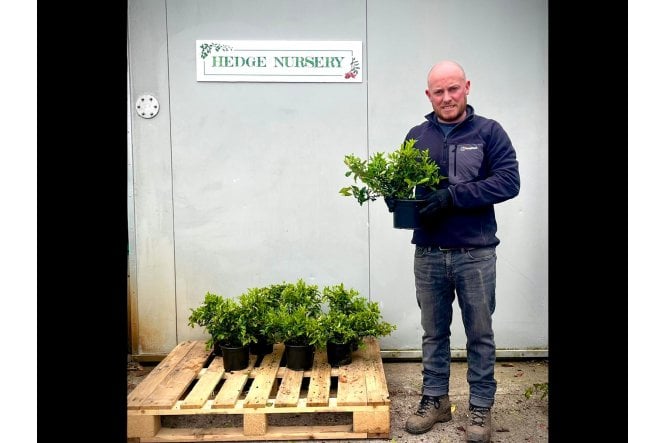
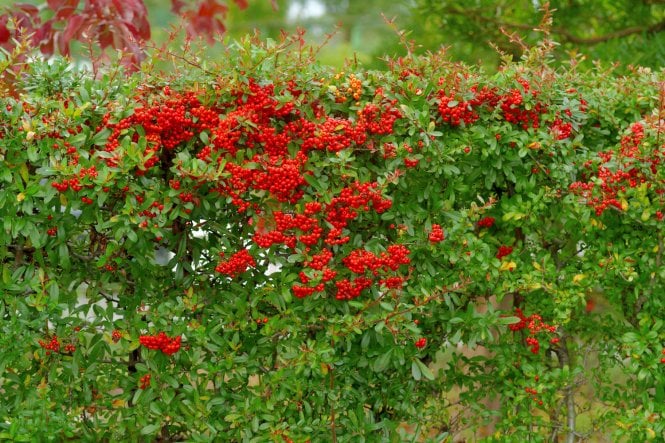
Pyracantha hedge plants with red berries (Firethorn 'Red Column')

  • Now From £5.99 (inc. VAT)
  • Save £1.00 (inc. VAT) Save 13%
Loading...
Automatic discounts, 2023-03-05

Pyracantha (Firethorn 'Red Column')

  • A very prickly evergreen hedging plant, ideal as an intruder-proof hedge
  • Profuse creamy, scented flowers in May, followed by clusters of bright red berries
  • Extremely good for wildlife - the birds absolutely love the berries
  • Good in sun or partial shade
  • Suitable for hedges 1m to 3m in height
  • Can be kept quite narrow
  • Excellent for growing as a wall climber
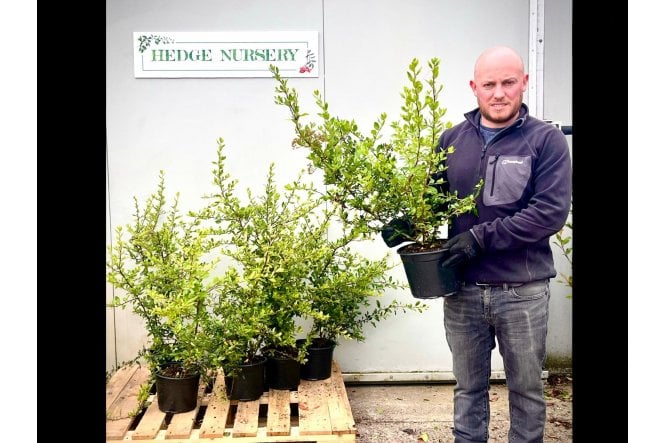
  • We have pot-grown Pyracantha in various sizes available year-round.

Please get in touch with us by phone (or email us at hello@hedgenursery.co.uk) if you have any questions, would like advice, or if your order is likely to come to over £1000 - we may be able to offer a better price than the online price.  Our experienced horticulturists answer calls and emails, and we’re always happy to help.

Pyracantha (Firethorn) with red berries is one of our most popular ornamental hedging plants and is useful for a wide range of situations. It is a top choice for keeping intruders away due to its strong spikes and stiff branch structure. It is also fantastic for wildlife – insects love the highly scented clusters of creamy coloured flowers with numerous stamens, and in early autumn you will see blackbirds and pigeons clinging to the shrub to feast on the ripened berries. Apparently, birds prefer the red-berried Pyracantha to those with orange or yellow berries. It is a useful plant because it can be kept relatively narrow. Finally, it is evergreen, so it is attractive year-round.

Pyracantha has small dark green leaves held on long stems. The stems can be trimmed in late spring or woven into the hedge's structure to thicken it. When the flowers are dying back, cut the new growth away from the flower clusters to allow sunlight to reach the spent flowers, which will help the berries to ripen. Pyracantha can be hard pruned to renovate or reshape an older plant or hedge, although this is likely to affect berry production in the following autumn or winter. This is because the berries are produced on second-year, or “old wood”. When trimming new shoots to expose berries to sunlight, make sure you retain some new wood to support berry production the following year. You will see improved flower and berry production if you feed and mulch each year in late winter.

Pyracantha thrives in full sun or partial shade and is very hardy, but berry production will be reduced if planted in dense shade. It is not recommended for coastal or highly exposed conditions. Flowering and fruiting will be particularly good if the plants are grown in full sun. It will grow well in most soil types of moderate fertility, including dry free-draining soil and heavy clay, provided the soil is not waterlogged. If planting against a wall or fence, plant 40–50cm away and water more frequently than for a freestanding hedge or shrub.

The name Firethorn comes from the Greek “pyr”, meaning fire, and “akanthos”, meaning thorn. It is native to Southwestern Europe (Spain) and Southeast Asia (China and Taiwan).

Due to its thorns, it is essential to wear thick gloves when handling and pruning this plant. While the berries are ornamental and highly attractive to wildlife, they are not intended for human consumption.

Hedge Nursery sells large quantities of Pyracantha hedge plants. Our reviews are excellent, and you can buy with confidence knowing that you will receive top-quality plants.

DELIVERY CHARGES

Delivery charges are automatically calculated at checkout, based on the size of the plants and the value of your order.  Our delivery charges and the kick-in points for free delivery are highly competitive, and about 90% of orders are delivered free.

Plant TypeUK Mainland (excl. Scottish Highlands and Islands)Scottish Highlands
Bare root plants shorter than 100cm, all cell-grown plants, plants in pots up to 7 Litres Free for orders over £120 (or £9.90) Free for orders over £120 (or £14.99)
Bare root plants 100-120cm Free for orders over £300 (or £24.99) Free for orders over £300 (or £29.99)
Bare root plants taller than 120cm, plants in pots larger than 7.5 Litres, all root ball plants and instant hedging Free for orders over £350 (or £59.99) £112.99

Notes:

  1. All prices include VAT.
  2. Orders of plants requiring delivery on pallets (bare root plants taller than 120cm, plants in pots larger than 7.5 Litres, root ball plants, and instant hedging) delivered to destinations in the UK Mainland are delivered free when the order is over £350, regardless of the number of pallets needed.
  3. Scottish Highlands do not have a free pallet delivery option.

DESPATCH TIMELINES

Most plant specifications are in stock, so we typically dispatch within a few days after you order.  Generally, we don't dispatch on Fridays, to avoid plants being in transit over a weekend.  Rest assured that we will do everything we can to deliver your plants as soon as possible.

You'll receive an email from us on the despatch day, and delivery will occur within 48 hours - usually the next day, but occasionally it may take an extra day.

If you'd like to delay delivery to a date that suits your planting schedule, please include a note in the Delivery Instructions section at checkout or email us at hello@hedgenursery.co.uk.

We do not take responsibility for any deliveries delayed by couriers.

Pre-orders

For pre-ordered plants with an expected future delivery date (shown before you added them to your basket), we will dispatch around the indicated date.  If your order includes both pre-order and in-stock items, we'll send everything together when the pre-order items become available.

Root Ball Plants

Root-ball plants are freshly lifted from our fields upon order.  This approach ensures the plants are at their freshest when you receive them, improving their success rate.  If you want delivery on a specific date, please order well in advance of when you need them.

During peak season, we lift root-ball plants twice weekly, aiming to deliver within 3-7 days.  During busy periods, this may extend to 7-14 days.  As the season slows, we lift once a week, with delivery within 7 working days.  We'll promptly inform you of any stock unavailability or delivery delays upon receiving your order.

RECEIVING DELIVERY (Do I need to be at home?)

All deliveries will be sent with “no signature required”, so you do not need to be at home on the day of delivery.

For pallet deliveries, we will phone or email you on the day we dispatch. If you wish, you can arrange for someone to be there the following day to ensure the pallet is left in a convenient place for you to unpack the plants.

Pallets are delivered to the ‘kerbside’, but if there is driveway access for a pallet truck, the pallet will be left on the driveway or another suitable access point to your address, rather than blocking a road or pavement. Pallet trucks require a hard surface; pallets cannot be moved over gravel, soft or uneven ground, or grass. 

Drivers do not unpack the pallets and it is down to the drivers discretion whether they will take the empty pallet away. If not, then customers must dispose of the pallet themselves.

RETURNS

We are rarely asked to accept a return.  We can facilitate returns by collecting the parcel (s) or palletised plants from you (in their original packaging), but we do not refund the delivery charge or the carrier collection and delivery back to us.  We do not accept returns if you have ordered too many plants.

If you wish to return an order, please email hello@hedgenursery.co.uk, and we will explain the process in more detail. 

Pots, bare roots, root balls, instant, cell grown, P9s - if it's all double Dutch, this explanation should help you decide which root type is best for you.

The majority of hedging plants are sold as bare roots, pot grown, or root balls, so we'll start with those.

Bare Root Hedging

For many years, we only sold bare roots, so there's a lot of advice on our website about bare root plants. Here's a very quick summary, along with links to other pages you might find helpful.

Bare root plants are grown in open fields and lifted during the winter months when dormant. This is the cheapest and most environmentally friendly growing method, so they are usually the best option if you are planting from November to April and the species and height combination you want is available as bare roots (about 80% of the species on this website are available as bare roots).

We sell hundreds of thousands of bare root plants each year to thousands of customers and, for a cost-effective solution, they're hard to beat.

We have a full explanation of the benefits and drawbacks, and an explanation of how they are grown on About Bare Root Hedging Plants, along with advice on Storing Bare Roots and Heeling in Bare Root Plants.

Pot Grown Plants

Everyone knows what a pot grown plant looks like, but there is often confusion about pot sizes and what you get for your money. Generally, with some exceptions, the bigger the pot size, the more mature, bushier and taller the plant will be - and the more costly.

Pot sizes are always described by the number of litres they hold. Our standard pot sizes are 2L, 5L and 10L (where L stands for litres). Pot dimensions from different manufacturers can vary, even though they all hold the same amount of growing medium, so sizes are specified by volume rather than the pot's dimensions.

There are several benefits to pot grown plants:

  • The range of species is very wide, with some only available in pots.
  • There is no root disturbance because they are grown in pots rather than lifted from fields, so the success rate is extremely high.
  • They can be planted year-round, though we always advise caution when planting in extremely warm weather - water generously until they are established!

Root Ball Hedging

For large plants, particularly big, bushy evergreens, the most popular root type is root balls. They are cheaper than pot-grown plants of the same height and often bushier, but they are only available during the dormant season, usually from October to April.

They're environmentally friendly because they are grown in open fields, but instead of lifting the plant bare rooted, soil is retained around the roots and wrapped in hessian. They are not quite as eco-friendly as bare roots because root balls are heavy to transport.

Read more About Root Balls here.

Instant Hedging Troughs or Ready-Grown Hedging

Instant hedging involves planting several plants (normally 5) into a 1 metre long trough and allowing them to knit together into a hedge, so that when planted by you, you get an instant effect.

Compared with other root forms, they are relatively expensive because if a single plant fails at the nursery, the whole trough is ruined. There is also a huge cost in nursery time because the plants are trimmed into a hedge shape by the nursery team and, in some more mature instant hedging, this is done many times so that the hedge becomes extremely dense.

Instant hedging is very popular and available year-round, and we are continually expanding the range of species grown this way. There's more information on instant hedging here, and we also have a blog explaining the benefits, drawbacks and how it is grown.

Cell Grown Plants

Small cell grown plants are grown by specialist nurseries in containers about the size of a small yoghurt pot, though a bit deeper because hedging plants and trees naturally have deep roots.

They are a cost-effective solution when gardeners are willing to wait for plants to grow, and they're ideal for infilling where there isn't enough space to plant larger root types. They are also often used by foresters because they are lightweight to carry to remote areas, easy to plant and have a high success rate, reducing the need for replanting.

They are increasingly used by home gardeners as hedging plants because, although they don't have the size and bushiness of pot-grown plants, they are less expensive and available year-round, making them a good alternative to small bare roots outside the bare root season.

There is very little root disturbance or loss of the fine feeding roots that plants rely upon when moved, so the success rate is extremely high. All our cell grown plants are grown in Britain.

We show prices in various bands depending on quantity, but if you are planting a woodland and need larger quantities, please contact us for a bespoke quote.

We're always happy to advise by phone or email, so please don't hesitate to contact us if you have any questions about the best root type for you.

PLEASE NOTE Our minimum order value is £50 inc VAT
Bare Root Pot Grown Root Ball Instant Hedging VIEW ALL

Available to Order Now

Product Options Root Type Planted Height Recommended Quantity DeliveryMore Info 1+ 25+ 50+ Quantity Qty
Pyracantha Red - 2 litre Root Type: Pot Grown Planted Height: 40/60cm Recommended Quantity: 3 - 5 per metre Pyracantha Red - 2 litre 1+ £6.99 (inc. VAT) Was £7.99 (inc. VAT) 25+ £6.49 (inc. VAT) Was £7.49 (inc. VAT) 50+ £5.99 (inc. VAT) Was £6.99 (inc. VAT) In stock
Pot Grown 40/60cm Free delivery on orders over £120 £6.99 (inc. VAT) Was £7.99 (inc. VAT) £6.49 (inc. VAT) Was £7.49 (inc. VAT) £5.99 (inc. VAT) Was £6.99 (inc. VAT)
0
Pyracantha Red - 2 litre Root Type: Pot Grown Planted Height: 60/90cm Recommended Quantity: 3 - 5 per metre Pyracantha Red - 2 litre 1+ £7.99 (inc. VAT) Was £8.99 (inc. VAT) 25+ £7.49 (inc. VAT) Was £8.49 (inc. VAT) 50+ £6.99 (inc. VAT) Was £7.99 (inc. VAT) In stock
Pot Grown 60/90cm Free delivery on orders over £120 £7.99 (inc. VAT) Was £8.99 (inc. VAT) £7.49 (inc. VAT) Was £8.49 (inc. VAT) £6.99 (inc. VAT) Was £7.99 (inc. VAT)
0
Total: £0.00 (inc. VAT)

BIODEGRADABLE AND RECYCLABLE RABBIT GUARDS

BAMBOO CANES

ROOTGROW